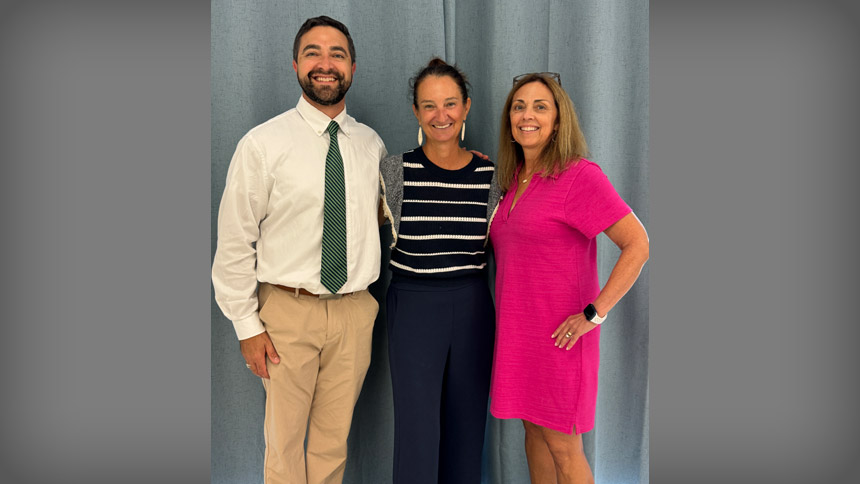



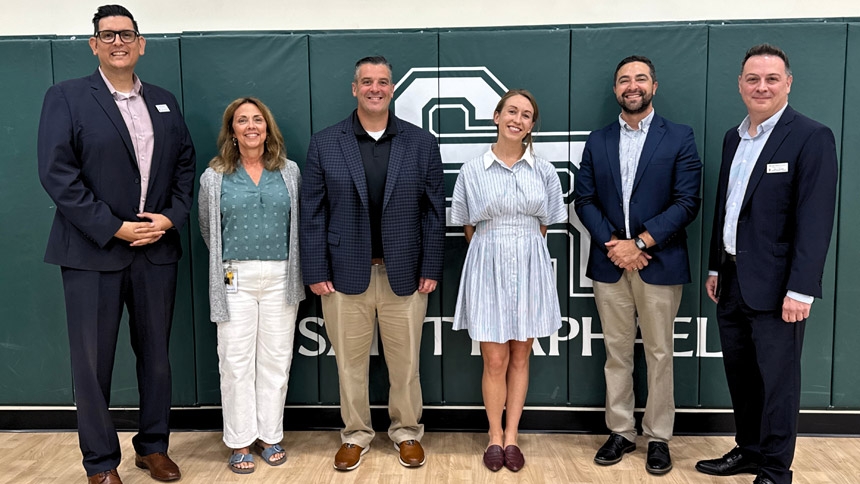
Above: (Left to Right): Marcelo Eureste, Winnie Reilly, Jake Dapolito, Dr. Lily Abadal, Joe Whitmore, Michael Mastrocinque
RALEIGH — St. Raphael Catholic School is launching a new schoolwide initiative called The Dignity of Learning, a multi-year effort that will guide how the school approaches technology, artificial intelligence, teaching and learning for years to come.
The initiative is the product of roughly a year of study, faculty feedback and survey responses from parents and students. At its core, Principal Joseph Whitmore said, is a simple conviction: “Formation is greater than information.”
“In an age of artificial intelligence and rapidly changing technology, our responsibility is not simply to help students use tools, but, much more importantly, to form young people who can think clearly, act responsibly, seek truth and use technology in ways that serve God and others,” Whitmore said.
To help launch the initiative, SRCS has partnered with two educators who are approaching the questions surrounding technology and AI from complementary perspectives. Dr. Lily Abadal, an assistant professor at the University of South Florida's Judy Genshaft Honors College and a consultant with Partners in Mission, is helping ground the work in Catholic teaching, human dignity and virtue. Dr. Meghan Manfra, a professor in North Carolina State University's College of Education, founder of Action in Professional Learning and parent of two SRCS alumni, is working alongside faculty on instruction, digital literacy, authentic assessment and thoughtful technology integration.
Winnie Reilly, the school's dean of curriculum and instruction, is working closely with both partners and helping lead implementation within the school. “When we began discussing this initiative last year, it became increasingly evident that this would encompass much more than AI and technology,” Reilly said. “This initiative is about protecting the dignity of the person: students, teachers, parents and administrators. It is about respecting the unique gifts and talents of all and remembering that all people are created in the image and likeness of God.”
A more intentional approach to technology
As part of the initiative, students in kindergarten through grade 3 will continue using classroom devices in developmentally appropriate, teacher-directed ways through small-group instruction, centers and classroom activities.
In grades 4-8, technology use will become more selective and teacher led. Chromebooks will remain at school in classroom carts and be used when teachers determine that technology adds value to a particular lesson rather than being individually assigned to students throughout the day or taken home each evening.
The shift does not mean less preparation for a technological world. The grades 4-8 Computer Science Program, led by Phyllis Zagrobelny in the Margaret A. Miller Innovation Lab, will continue, with students engaging in robotics, coding and essential computer science skills. Seventh and 8th grade students will also participate in structured, teacher-guided AI capstone work.
“SRCS is not abandoning technology, nor are we pretending our students are growing up in a world without it,” Whitmore said. “Technology and AI are becoming more powerful and more present. Our students need stronger formation, clearer boundaries, deeper thinking and more intentional guidance.”
Rooted in listening and formation
The initiative grew out of extensive listening. Since October 2025, school administrators have surveyed and met with faculty, parents and students about technology use in the classroom. A consistent theme emerged: technology can add tremendous value to learning, but it should not drive the learning experience.
That listening has led to significant formation for the adults who will guide students.
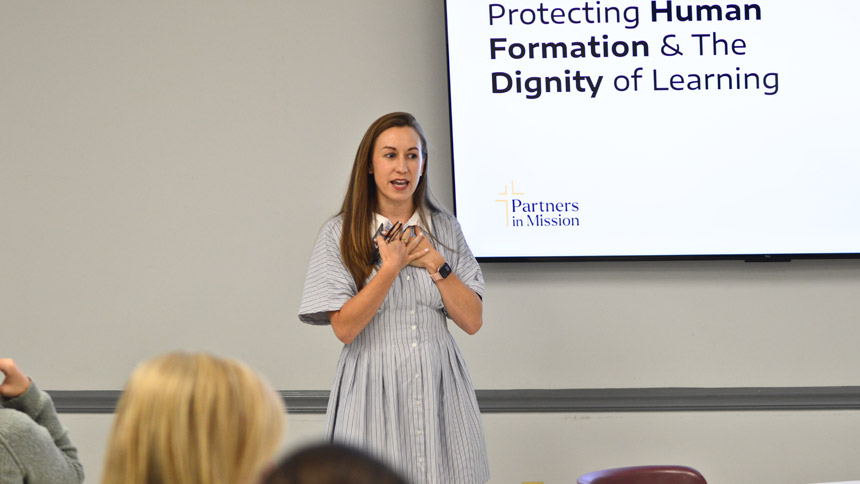
Faculty and staff spent the summer studying Pope Leo XIV's Magnifica Humanitas and then gathered with Abadal during teacher work week for a morning of formation centered on Catholic anthropology, human dignity and the responsibility of educators in an age increasingly shaped by technology and AI.
Abadal said the phrase “the dignity of learning” itself grew out of her work with DELTA at the University of Notre Dame's Institute for Ethics and the Common Good, which focuses on human formation in the age of AI.
“I first encountered the phrase ‘the dignity of learning’ through collaboration with the Institute for Ethics and the Common Good's DELTA project at Notre Dame,” Abadal said. “The folks there believe — and I agree — that in order to understand how we should interact well with AI as educators, we first need a better grasp on what makes learning dignified.”
For Abadal, intentional limits on technology are not a rejection of innovation but part of a broader commitment to human formation.
“St. Raphael's is rightly prioritizing student formation, which includes character development, intellectual development, social development, and spiritual development,” she said. “Being more intentional about limits and purposeful use instead of presuming technology should be incorporated into every lesson will help young people better form healthy relationships to technology — relationships ordered to their flourishing as human beings.”
Parents join the conversation
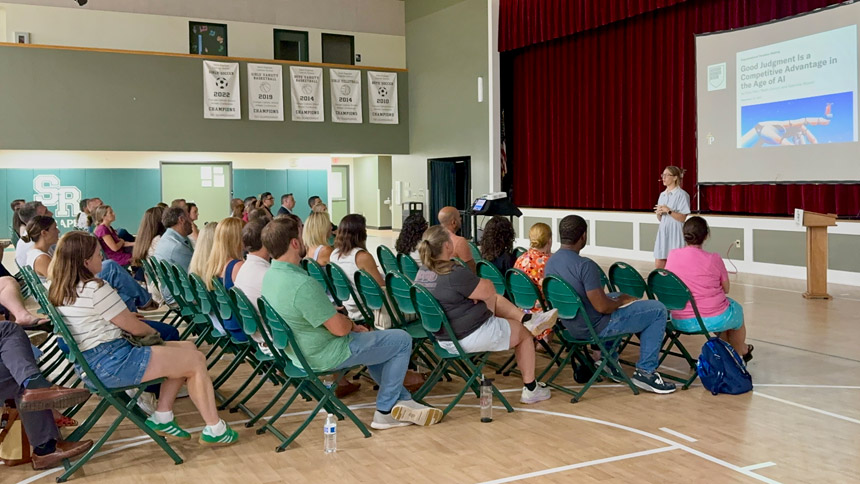
That same formation extended to families Aug. 6, when Abadal led a parent formation session. The event was well attended, with families representing every grade level from preschool through grade 8.
Parents came with thoughtful and practical questions, such as How will middle school students receive and complete homework without a school-issued Chromebook at home? Will they still develop the technological independence they will need in high school? How can families help children develop healthy digital habits and learn to evaluate AI-generated information?
School leaders said those are precisely the kinds of questions the Dignity of Learning initiative is intended to engage.
Students will continue to receive assignments, complete meaningful work at home, learn digital tools, conduct research, and develop the technological skills needed for high school and beyond. The change is not intended to remove those experiences. Rather, the school is moving away from default access toward intentional use, allowing teachers to determine when technology genuinely strengthens learning.
The broader goal is not to make students less capable with technology, but more capable of determining when and how to use it well.
For Tony Vance, a current parent and member of the School Advisory Committee, the direction of the initiative has reinforced his confidence in the school.
“I'm so happy my kids are Guardians, and I'm proud of the way Mr. Whitmore is leading our school community,” Vance said.
Formation and structure
Assistant Principal Jake Dapolito said the work with Abadal has also helped school leaders articulate the relationship between formation and appropriate boundaries.
“With the help of Dr. Abadal, our dignity initiative has helped me rearticulate what we do at SRCS,” Dapolito said. “It's one part formation and one part structure. Formation is how we dignify the students. Without formation, structure is punitive. But without structure, there can be no dignity and no formation.”
That understanding is reflected in the school's developing AI and technology policies, which emphasize character, intellectual, social and spiritual development for students while also protecting teacher expertise, relationships and trust.
Another expression of the dignity of learning
The school is also launching an Academic Enrichment Program for grades 3 and 4 alongside the Dignity of Learning initiative.
Whitmore sees the pilot, which supplements the school's existing academic support services, as another expression of the same underlying philosophy.
“Just as we want technology to serve each learner well, we also recognize that students learn differently and deserve opportunities to be appropriately challenged,” he said. “Some students need additional support. Others need additional enrichment. Every student deserves to be known, challenged, and formed well.”
What comes next
The work continued this week as faculty began their instructional partnership with Manfra, who co-leads the University of North Carolina System's AI Foundational Skills Training Initiative.
In the first session, Manfra emphasized the essential role of digital literacy as technology continues to evolve, while also challenging faculty to continue forming the “durable skills” that matter regardless of which tool a student is using. The goal is not to prepare students for one particular platform, device or version of AI, but to develop the human capacities that allow them to continue learning and adapting as those tools change.
For SRCS, that combination is central to the Dignity of Learning: students should be technologically capable without becoming technologically dependent.
“As a Catholic school, we have a moral responsibility to ensure that we are forming our students in the Catholic tradition centered around the dignity of each person,” Whitmore said. “That dignity is not earned. It is inherent in who we are. So, as a faculty and staff, we are responding to that responsibility by providing high-quality professional development that not only helps us remember what we must keep human in our lessons, but also how we can become more digitally literate in the rapidly changing technological world our students will one day work in.”
Whitmore said the school does not view the initiative as a finished product.
“We do not have all of the answers. In fact, more questions have come about over the past week than answers, and that is the fun part,” he said. “We feel confident in the system changes that have been made this year and will continue to focus our instruction on the learning process rather than being hyperfocused on the outcome.”
“This is not a one-year initiative or a quick fix,” Whitmore added. “It is the beginning of a longer journey. We know we will continue to learn, listen and make adjustments along the way.”
Anna Bragg is the director of marketing and enrollment management for the Diocese of Raleigh’s Catholic Schools Office.
Photos