



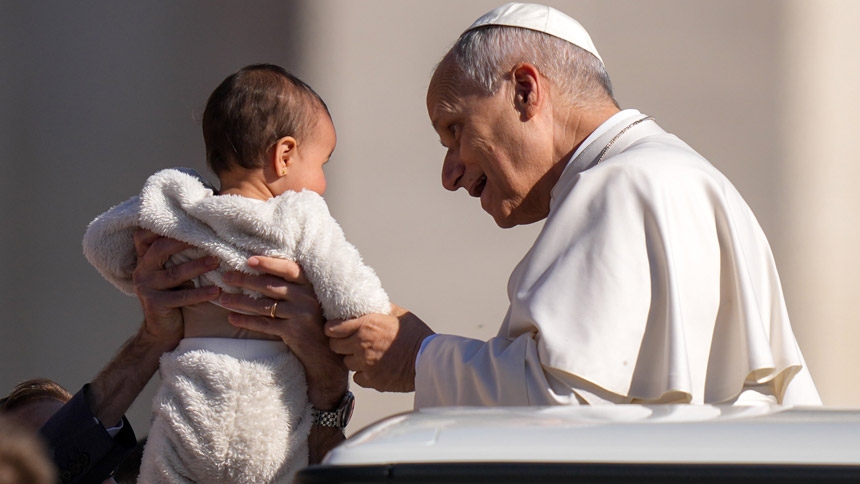
Above: Pope Leo XIV greets a child from the popemobile while riding around St. Peter’s Square at the Vatican before his weekly general audience April 8, 2026. (CNS photo/Lola Gomez)
VATICAN CITY — Pope Leo reminded Catholics today that holiness is not reserved for saints, clergy or religious, but is a calling shared by every baptized person.
Continuing his series of catecheses on the documents of the Second Vatican Council, the pope reflected on Lumen gentium, the Dogmatic Constitution on the Church, focusing on its teaching about holiness and the evangelical counsels of poverty, chastity and obedience.
“Holiness, according to the Conciliar Constitution, is not a privilege for the few, but a gift that requires every baptized person to strive for the perfection of charity, that is, the fullness of love towards God and towards one’s neighbour,” Pope Leo said.
Love at the center of Christian life
Pope Leo emphasized that love — or charity — is at the heart of holiness and is not simply one virtue among many.
“Charity is, in fact, the heart of the holiness to which all believers are called: infused by the Father, through the Son Jesus, this virtue ‘rules over all the means of attaining holiness and gives life to these same means,’” he said, quoting Lumen gentium.
The pope explained that holiness takes many forms in everyday life, especially through faithfulness, service and commitment to justice. While martyrdom remains the highest witness of faith, he said, all Christians are called to make Christ visible through their lives.
“The highest level of holiness, as in the early days of the Church, is martyrdom, the ‘supreme witness of faith and charity,’” Pope Leo said, adding that believers live this readiness whenever they leave “signs of faith and love in society.”
Nourished by the sacraments
The pope also pointed to the sacraments — especially the Eucharist — as essential sources of strength for living a holy life.
“All the Sacraments, and in a pre‑eminent way the Eucharist, are nourishment that fosters a holy life, assimilating every person to Christ, the model and measure of holiness,” he said.
Holiness, he stressed, begins with God’s gift and grows through cooperation with grace. It is not about achieving perfection through effort alone but about allowing God to transform one’s heart.
Quoting Saint Paul VI, Pope Leo recalled that the Church can only be authentic when her members truly strive for holiness, which he described as “an inner transformation” shaped by the Holy Spirit.
A holy Church made of imperfect people
Addressing the reality of sin within the Church, Pope Leo acknowledged that holiness is lived out amid human weakness.
“The sad reality of sin in the Church, that is, in all of us, invites each person to carry out a serious change of life, entrusting ourselves to the Lord, who renews us in charity,” he said.
For this reason, holiness is not just a moral ideal or a set of good behaviors.
“Therefore, holiness does not only have a practical nature, as if it were reducible to an ethical commitment, however great, but concerns the very essence of Christian life, both personal and communal,” the pope said.
Religious life as a sign for all
Turning to consecrated life, Pope Leo explained that religious men and women live as a visible reminder of the holiness to which all are called.
The evangelical counsels, he said, are not limitations but gifts that free the heart.
“These three virtues are not rules that shackle freedom, but liberating gifts of the Holy Spirit,” he said, explaining that poverty fosters trust in God, obedience reflects Christ’s self‑giving, and chastity expresses wholehearted love for God and the Church.
By living these counsels radically, consecrated persons point the entire Church toward Christ and the mystery of the Cross.
“By contemplating this event, we know that there is no human experience that God does not redeem: even suffering, lived in union with the passion of the Lord, becomes a path of holiness,” Pope Leo said.
He concluded by entrusting all believers to Mary’s care.
“May the Virgin Mary, the all‑holy Mother of the Incarnate Word, always sustain and protect our journey,” the pope said.