


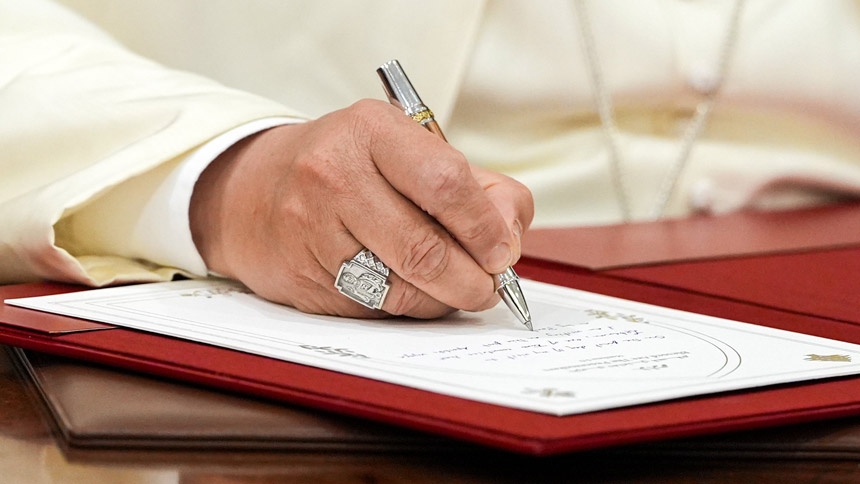
Above: Pope Leo XIV signs the Book of Honor at the presidential palace in Beirut Nov. 30, 2025. (CNS photo/Lola Gomez)
VATICAN CITY (AP) — Pope Leo XIV will release a landmark encyclical on artificial intelligence and human dignity May 25, marking a significant new chapter in Catholic social teaching as the Church confronts the ethical challenges of rapidly advancing technology.
The document, titled “Magnifica Humanitas” (“Magnificent Humanity”), was signed May 15 — the 135th anniversary of Pope Leo XIII’s “Rerum Novarum,” the foundational text of modern Catholic social doctrine focused on workers’ rights. The new encyclical is widely anticipated to address the protection of the human person in the age of artificial intelligence.
The Vatican said the encyclical will be presented the day after Pentecost during a panel discussion in the Synod Hall. In a highly unprecedented move, Pope Leo himself is expected to attend the presentation, delivering an address and apostolic blessing — a rare level of direct papal involvement for such an event.
The panel will feature a mix of senior Vatican officials, theologians and technology experts, reflecting the interdisciplinary nature of the issue. Speakers include Cardinal Víctor Manuel Fernández, prefect of the Congregation for the Doctrine of the Faith; Cardinal Michael Czerny, prefect of the Dicastery for Promoting Integral Human Development; and theologian Anna Rowlands, a professor at Durham University in England known for her work in Catholic social thought and practice, political theology, and the theological ethics of human migration.
They will be joined by Christopher Olah, co-founder of U.S.-based artificial intelligence company Anthropic and a leading researcher on AI interpretability, as well as Léocadie Lushombo, a professor of theological ethics at the Jesuit School of Theology of Santa Clara University in Berkeley, Calif. Both Rowlands and Lushombo are members of the Dicastery for the Promotion of Integral Human Development. Cardinal Secretary of State Pietro Parolin will offer concluding remarks.
Importance of the release date
The timing of the release underscores its historical and theological significance. Pope Leo XIII issued “Rerum Novarum” on May 15, 1891, just days before Pentecost that year, inaugurating what would become a sustained body of Catholic teaching on social and economic life. A century later, St. John Paul II commemorated the milestone with his 1991 encyclical “Centesimus Annus,” also published near Pentecost.
Celebrating Mass in St. Peter's Square with an estimated 100,000 people, including workers and labor representatives from 15 countries, Pope John Paul said Pope Leo XIII was inspired by the Holy Spirit to proclaim the Gospel in the language of his day and declare the evil of "social sin."
Just as the Holy Spirit at Pentecost enabled the disciples to address the crowd in a way each would understand, the Holy Spirit helped Pope Leo XIII communicate the truth of the Gospel to his contemporaries with the encyclical "Rerum Novarum" on capital and labor, he said.
Filled with the Holy Spirit at Pentecost, the apostles "spoke and speak with the always new language of human experience of the problems and human needs appropriate to individuals, communities, nations and the entire human family," the pope said.
The language Pope Leo XIII used "marked the beginning of a new teaching of the Church," which has been built on by succeeding popes, individual bishops and groups of bishops, he said.
"This specific teaching, which is called social doctrine, expresses and fulfills an aspect of the mission which the Apostles received from Jesus Christ," Pope John Paul said.
Latest from the Vatican on AI
The release of “Magnifica Humanitas” appears poised to extend that tradition into the digital age. Vatican officials have increasingly signaled concern about the ethical implications of artificial intelligence, including its impact on human dignity, labor, communication and social cohesion.
Pope Leo XIV agreed to the creation of an inter-dicasterial commission on Artificial Intelligence during an audience with Cardinal Michael Czerny, prefect of the Dicastery for Promoting Integral Human Development, at the Vatican May 3, 2026.
The Vatican made the announcement May 16, explaining the body was being set up because of: how quickly and widely the use of Artificial Intelligence has grown; its potential effects on human beings and on humanity as a whole; and the Church's concern for human dignity, especially in relation to their integral development.
The commission, established by Cardinal Czerny and coordinated by the dicastery he heads, will be made up of representatives from:
- the Dicastery for Promoting Integral Human Development;
- the Dicastery for the Doctrine of the Faith
- the Dicastery for Culture and Education;
- the Dicastery for Communication
- the Pontifical Academy for Life
- the Pontifical Academy of Sciences and the Pontifical Academy of Social Sciences.
The group will engage in "activities and projects concerning Artificial Intelligence, including policies on its use within the Holy See, promoting dialogue, communion and participation."
More news on Pope Leo and AI
Let communication be conducted by real human beings, not AI, pope says - May 15, 2026
Local professor, theologian is part of commission for Vatican document - April 1, 2026
Pope tells U.S. high school students their voice, ideas, faith matter - November 24, 2025
Pope: Intelligence is seeking life's true meaning, not having reams of data - June 20, 2025