


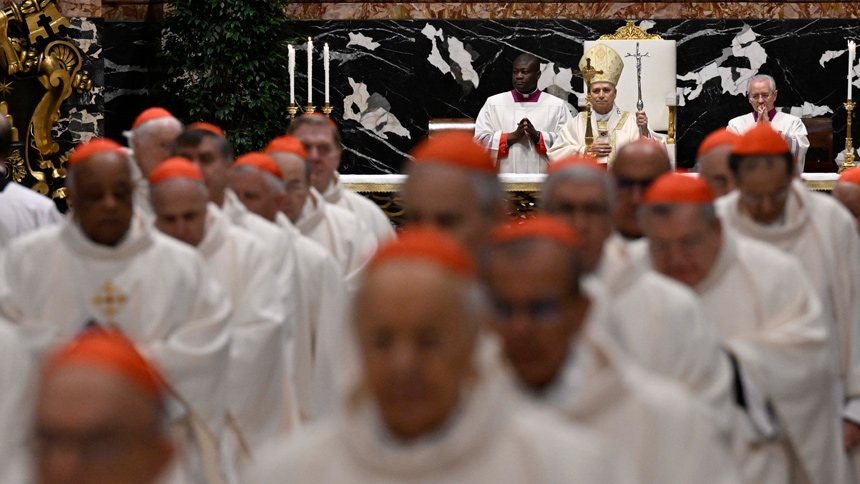
Above: Pope Leo XIV celebrates Mass in St. Peter’s Basilica at the Vatican with the members of the College of Cardinals gathered for his first extraordinary consistory Jan. 8, 2026. (CNS photo/Vatican Media)
VATICAN CITY (CNS) -- Pope Leo XIV and members of his College of Cardinals have begun what is a kind of synodal journey together to grow in communion and discern together "what the Lord is asking of us for the good of his people."
After convening the international group of cardinals in Rome for an extraordinary consistory Jan. 7-8, the pope decided to make the gathering an annual event, however with an additional meeting later this year.
It marked an approach that vastly expanded on what Pope Francis established after his election in 2013. Wishing for a more decentralized and listening Church, the late pope created a nine-member Council of Cardinals to help and advise him on several critical matters facing the Church, particularly the reform of the Roman Curia, by meeting at least quarterly in Rome.
Pope Leo decided he would be inviting all the world's cardinals to Rome every year for a few days, Matteo Bruni, director of the Vatican press office, told reporters at a news conference after the consistory ended Jan. 8.
College members will meet with the pope again for at least three days sometime in June, possibly around the feast of Sts. Peter and Paul, June 29, and then the gathering will be held over three to four days once a year in the following years.
The College of Cardinals is made up of 245 cardinals from all over the world. About 170 of them -- about 69% -- made it to Rome after the pope's invitation Dec. 12 that they come together again for the first time since the conclave that elected him May 8.
Cardinal Timothy Radcliffe, a Dominican theologian, offered a reflection Jan. 7 to help the cardinals understand their role not just as advisers to the pope, but as much-needed companions along life's way.
He recalled St. Mark's account of Jesus making his disciples go out ahead of him by boat, which encountered a "great storm."
Jesus does not want Peter or any of the disciples to go into the storm alone, he said. "This is our first obedience, to be in the barque of Peter, with his successor, as he faces the storms of our times."
Some of the storms shaking the Church, he said, include "sexual abuse and ideological division. The Lord commands us to sail out into these storms and face them truthfully, not timidly waiting on the beach. If we do so in this consistory, we shall see him coming to us. If we hide on the beach, we shall not encounter him."
However, Cardinal Radcliffe said, "If the boat of Peter is filled with disciples who quarrel, we shall be of no use to the Holy Father. If we are at peace with each other in love, even when we disagree, God will indeed be present even when he seems to be absent."
Pope Leo emphasized the essential element of love in his opening remarks to the cardinals in the Vatican's Synod Hall Jan. 7.
"To the extent that we love one another as Christ has loved us, we belong to him, we are his community, and he can continue to draw others to himself through us. In fact, only love is credible; only love is trustworthy," he said.
"Therefore, in order to be a truly missionary Church, one that is capable of witnessing to the attractive power of Christ's love, we must first of all put into practice his commandment … 'Just as I have loved you, you also should love one another,'" the pope said. Jesus underlined that it will be by a Christian's love that the world will know "that you are my disciples."
The "collegial journey" that they have begun with their first consistory, he said, would be an opportunity to reflect together on two themes of their choice out of the following four themes: the mission of the Church in today's world, especially as presented in Pope Francis' "Evangelii Gaudium"; the synod and synodality as an instrument and a style of cooperation; the service of the Holy See, especially to the local Churches; and the liturgy, the source and summit of the Christian life. The cardinals voted with "a large majority" to discuss the first two themes -- mission and synodality, Bruni told reporters.
Following a synodal structure, the cardinals were broken into 21 groups, but nine of those groups, made up of cardinals under 80 years old, who were not resident in Rome, were asked to submit reports based on their small group discussions, which followed the Synod on Synodality's "conversation in the Spirit" method.
"I am here to listen," Pope Leo told the cardinals before they began their two days of reflection and dialogue.
"We must not arrive at a text, but continue a conversation that will help me in serving the mission of the entire Church," he said. Specifically, he wanted the groups to look at the next one or two years and consider what "priorities could guide the action of the Holy Father and of the Curia regarding each theme?"
The pope further encouraged the cardinals the next day in his homily during an early morning Mass in St. Peter's Basilica.
Their task, he said, was to discern what "the Lord is asking of us for the good of his people," not "to promote personal or group 'agendas.'"
Through prayer, silence, listening and sharing, he said, "we become a voice for all those whom the Lord has entrusted to our pastoral care in many different parts of the world."
Speaking to reporters at a news conference after the consistory, Cardinal Luis José Rueda Aparicio, archbishop of Bogotá, Colombia, said the experience "strengthened us" individually and as a group as they got to know each other better.
The pope underlined how important hope was in the life and mission of the church, he said. When Christ is at the center of one's life, proclaiming his word "fills us and the world with hope."
Cardinal Stephen Brislin, archbishop of Johannesburg, South Africa, told reporters the vast differences between cardinals -- with their different perspectives and needs -- proved to be "very enriching" and interesting, and not a source of contention.
Cardinal Pablo Virgilio David, bishop of Kalookan, Philippines, told reporters the synodal format and style of the consistory "was familiar" to those who had taken part in the synodal assemblies in Rome in 2023 and 2024.
When asked if it seemed the pope was going to use their sessions to inform or contribute to any kind of papal document, Cardinal David said, "I don't know," but the pope was "taking notes very seriously so he must be up to something."
Cardinal Brislin said there is no indication that a document was the aim of the gathering, and it was more a concrete response to the cardinals' request that they meet.
Cardinal Aparicio said by listening to all the world's cardinals, the pope "listens to the different parts of the world."