

ABOARD THE PAPAL FLIGHT FROM LIMA TO ROME (CNS) -- In an unusually long press conference with journalists aboard his flight back to Rome after a 12-day journey through South America, Pope Leo XIV spent 45 minutes making one thing clear: Unity comes first.
"For right now, what I believe (is) an important part of my ministry to the Church is to heal, bring people together," he said Nov. 16, saying that promoting unity, communion and dialogue among all members of the Church offers a way for "how we walk forward" amidst so much polarization in the world.
While Pope Leo has repeatedly stressed the importance of unity and peace throughout the world, placing them at the center of his papacy, his response to a question about ordaining married men to address priest shortages offered a clearer picture of how that priority may shape his decisions as pope.
The proposal, he said, is one that "in certain areas of the Church can cause division because there is not universal, if you will, acceptance of that concept."
Asked whether the possibility of ordaining mature married men remains open, Pope Leo said the Holy Spirit may continue to suggest changes, but emphasized that such decisions require discernment by the wider Church.
"The pope doesn't change Church doctrine. We all have to listen. The bishops have to listen. It may be in the future that some things will change," he said.
But for now, he said, one of his priorities is "first to promote unity and communion among us as members of the Church."
"First, let's come together. Let's consider what we believe the priorities need to be. And then we'll see how we walk forward from there," he said.
Pope Leo acknowledged that many Catholics disagree with his approach, but said the question of married men as priests is "complicated" and that considering possible changes would take time.
Restrictions remain in place
The pope expressed a similar desire to avoid division when asked whether he would relax restrictions on the celebration of the traditional Latin Mass imposed by Pope Francis in his 2021 apostolic letter, "Traditionis Custodes."
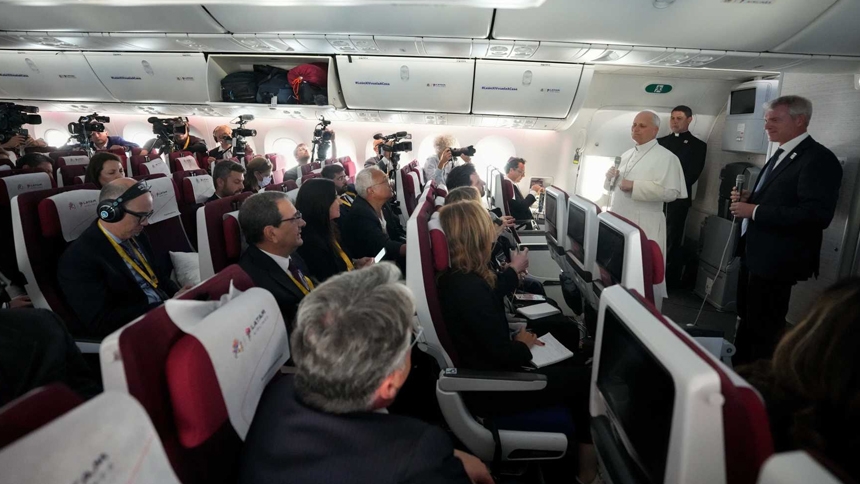
Pope Leo XIV speaks with journalists aboard his flight back to Rome Nov. 16, 2026, after concluding his apostolic journey to Uruguay, Argentina andsdttt Peru. (CNS photo/Lola Gomez)
"We will continue to follow that," Pope Leo said, noting that the existing rules provide avenues for obtaining permission to celebrate the older form of the Mass.
He said the vast majority of Catholics celebrate Mass according to the rite promulgated after the Second Vatican Council and that he did not see a need to change the current restrictions.
Polarization and economic concerns
Another pillar of Pope Leo's pontificate has been addressing concerns surrounding rapid technological advancements, which he has warned can deepen political and cultural divisions.
"Increasingly, I believe we are all realizing how we have been swayed by algorithms and a polarization that is not accidental, but intentionally provoked," he said in Spanish.
Reflecting on the enormous crowds that gathered for his visit to Argentina, Pope Leo pointed to the shared enthusiasm of people across the political spectrum as evidence that reconciliation remains possible.
"How is it possible that the right, the left, all of us were there in the streets celebrating and enjoying something much greater than a political discussion?" he asked.
He said he hoped his visit would encourage people to recognize that differences of opinion do not have to lead to hatred, violent language or divisions so deep that even family members can no longer speak to one another.
The pope also addressed his meetings with Argentine President Javier Milei, whose political positions have often differed sharply from those of Pope Francis.
"Although there are some who try to force me, in some countries, toward the right, toward the left, to criticize or not criticize," he said. " “I insist that the message I want to give, the message I want to bring, is not political."
Pope Leo said he and Milei discussed Argentina's economic difficulties, the dignity of human life and the need to give greater consideration to the most vulnerable members of society.
Responding to another question about the economic hardship facing Argentina's middle class, the pope warned against the growing concentration of wealth and emphasized the importance of a more equitable distribution of resources.
He called on political leaders and citizens to work together to improve living conditions, create employment and strengthen the working class so that people can live with greater dignity.
The pope's surgery and health care
During the lengthy press conference, Pope Leo appeared at ease, joking with journalists about their exhaustion after the demanding journey and sharing new details about his recent lung cancer diagnosis.
"The initial news came as a surprise," he said in Italian. "There were no symptoms, and I felt fine."
He said doctors first detected a shadow during a routine annual checkup. Further examinations revealed a tumor.
Last month, the pope underwent surgery to remove the lower lobe of his right lung after the cancerous nodule was discovered. He was discharged from the hospital four days later, but questions remained about whether his stamina would be sufficient for a demanding journey through Uruguay, Argentina and Peru, including visits to cities at high elevations.
Pope Leo said the tumor had been completely contained in the portion of the lung that was removed and that no further treatment was necessary, although he would continue undergoing regular medical examinations.
Pope Leo XIV speaks with journalists aboard his flight back to Rome Nov. 16, 2026, after concluding his apostolic journey to Uruguay, Argentina and Peru. (CNS photo/Lola Gomez)
He said his experience reinforced the importance of preventive care and encouraged people not to be afraid to seek regular check-ups and medical treatment when necessary.
Asked whether he had signed a conditional resignation letter to take effect in the event that he became incapacitated, as some of his predecessors had done, Pope Leo responded simply, "No."
"For now, I don't see the need, thanks be to God," he added, noting that canon law already contains provisions addressing some of the relevant questions.
He said he might eventually sign such a letter but did not consider it necessary at present.
The warm reception in Peru
The pope also reflected on the extraordinary reception he received in Peru, where he spent decades as a missionary and bishop before his move to Rome as head of the Vatican's Dicastery for Bishops and then his election to the papacy.
He joked about a pilgrim who had thrown a rosary toward him, hitting him in the eye during the visit, saying the gesture had come from a desire to offer him a gift of faith.
"These are things that one carries in the heart, perhaps in the eye," he said in Spanish.
But he also made clear that the enthusiasm generated by his visit would need to be sustained by local church leaders.
"Now it's your turn," he said he had told the bishops, urging them to continue nurturing the faith and devotion expressed during the papal visit.
Addressing his meeting with victims who reported abuse by members of the Church in Peru, Pope Leo said the encounter represented both a desire to remain close to survivors and a commitment to preventing further abuse.
He called on bishops and pastoral workers to take responsibility for accompanying victims, seeking justice and ensuring that such crimes are not repeated.
The pope also said the Vatican was studying how to define spiritual abuse in canon law, although no document on the subject was ready for publication.
Future papal trips and his American identity
Asked about the possibility of future trips, including a visit to the United States, Pope Leo said plans for 2027 were still being considered. He confirmed that he would travel to South Korea for World Youth Day but declined to announce other destinations.
The question prompted a reflection on the role his American upbringing had played in shaping his identity, even after decades spent living and ministering in Peru.
"In many ways, I am a 'gringo,' a North American," he said in Spanish, describing his deep belief in democracy as part of his American identity.
Although his experience in Peru had transformed the way he lived his faith, Pope Leo said his upbringing in a multicultural American family had also profoundly shaped him.
While the first U.S.-born pope offered no indication of when he might return to his country of birth, he left open the possibility of a future visit.