


Curriculum & Instruction
Our Commitment to Academic Excellence
The Diocese of Raleigh Office of Catholic Schools is committed to providing students with a rigorous, faith-filled education that prepares them for success in college, career, and life. Our curriculum and instructional practices reflect both the teachings of the Catholic Church and the high academic expectations established for all students in North Carolina.
Catholic schools in the Diocese of Raleigh are aligned to the North Carolina Standard Course of Study. By grounding our academic programs in these standards, we ensure that every student — from kindergarten through twelfth grade — receives an education that is both academically challenging and benchmarked against the expectations of the state of North Carolina. This alignment supports the seamless transition of students across grade levels and schools while maintaining the distinctive Catholic identity and mission at the heart of everything we do.
Curriculum
Standards Alignment
All diocesan schools implement instructional programs aligned to the North Carolina Standard Course of Study (NCSCS). This framework guides instruction in core subject areas including English Language Arts, Mathematics, Science, and Social Studies. Teachers plan and deliver lessons using these standards as the foundation, ensuring that all students develop the essential knowledge and skills appropriate for their grade level.
Catholic Identity Integration
While our academic standards align with those of the state, our curriculum is distinctively Catholic. Religious education is woven throughout every aspect of school life, and teachers are encouraged to integrate Gospel values, the teachings of the Church, and a Catholic worldview across all subject areas. Our schools are not simply academic institutions — they are communities of faith where the whole child is educated in mind, body, and spirit.
Core Subject Areas
Diocesan schools provide comprehensive instruction across the following core disciplines:
- English Language Arts – Reading, writing, speaking, listening, and language
- Mathematics – Number sense, algebra, geometry, data analysis, and problem-solving
- Science – Life, physical, and earth sciences with inquiry-based learning
- Social Studies – History, civics, geography, and economics
- Religion – Systematic catechesis aligned with the United States Catholic Catechism for Adults
- Fine Arts, Physical Education, and World Languages – Offered in accordance with school resources and grade-level programming
- Preschool/ECC - Preschool/ECC standards (PDF)
Instruction
Effective instruction in diocesan schools is rooted in research-based best practices and a deep understanding of how students learn. Teachers are supported through ongoing professional development, collaborative planning, and instructional coaching to ensure they are equipped to meet the diverse needs of all learners.
Our instructional philosophy emphasizes high expectations for all students, differentiated instruction to meet individual learning needs, data-informed decision-making, and a classroom culture that is both rigorous and nurturing. We believe that every child is made in the image and likeness of God and is therefore deserving of the very best education we can provide.
Professional Development
The Office of Education provides teachers and administrators with regular professional development aligned to both instructional priorities and Catholic school mission. Training opportunities address curriculum implementation, data literacy, assessment practices, instructional strategies, and faith formation for educators.
Assessment
Assessment is an essential component of effective teaching and learning. In the Diocese of Raleigh, we use a variety of assessments to measure student progress, inform instruction, and ensure that all students are on track to meet grade-level expectations. Our assessment program includes both formative measures used day-to-day in the classroom and summative assessments that provide a broader picture of student performance over time.
Grades K–8: i-Ready Diagnostic
Students in Kindergarten through Grade 8 participate in the i-Ready Diagnostic assessment three times per year — at the beginning, middle, and end of the school year. The i-Ready Diagnostic is a nationally normed, adaptive assessment that measures student performance in Reading and Mathematics. Each administration provides teachers with detailed data on individual student strengths and areas for growth, enabling targeted instructional decisions.
The three annual administrations serve distinct purposes:
- Fall – Establishes a baseline for each student at the start of the school year and informs initial instructional groupings and plans
- Winter – Measures mid-year growth, allowing teachers to adjust instruction and provide additional support where needed
- Spring – Documents end-of-year growth and informs planning and instructional decisions for the following school year
Results from the i-Ready Diagnostic are shared with teachers, school administrators, and families to promote transparency and partnership in supporting student achievement.
High School: College Readiness Assessments
Students in diocesan high schools participate in a sequence of college readiness assessments designed to prepare them for post-secondary success. These assessments help students identify strengths and areas for improvement, familiarize them with college admissions testing formats, and provide actionable data to guide academic planning.
High school students in the Diocese of Raleigh participate in the following assessments:
- PSAT (Preliminary SAT) – Administered to students in Grades 9 and 10; provides an early indicator of college readiness in Evidence-Based Reading and Writing and Math, and prepares students for the SAT
- SAT (Scholastic Assessment Test) – A nationally recognized college admissions examination taken by students in Grades 11 and 12; assesses college and career readiness and is widely used in the college application process
- Pre-ACT – Administered to students in Grades 9 and 10 as a practice measure for the ACT; provides early feedback on academic readiness in English, Mathematics, Reading, and Science
- ACT (American College Testing) – A nationally recognized college admissions examination taken by students in Grades 11 and 12; assesses English, Mathematics, Reading, and Science reasoning skills and is used in the college application and scholarship process
Together, these assessments form a comprehensive college readiness pathway that begins in ninth grade and continues through senior year. Schools use results to guide counseling conversations, support academic planning, and connect students with the resources they need to achieve their goals.
Spring 2026 i-Ready Diagnostic Results
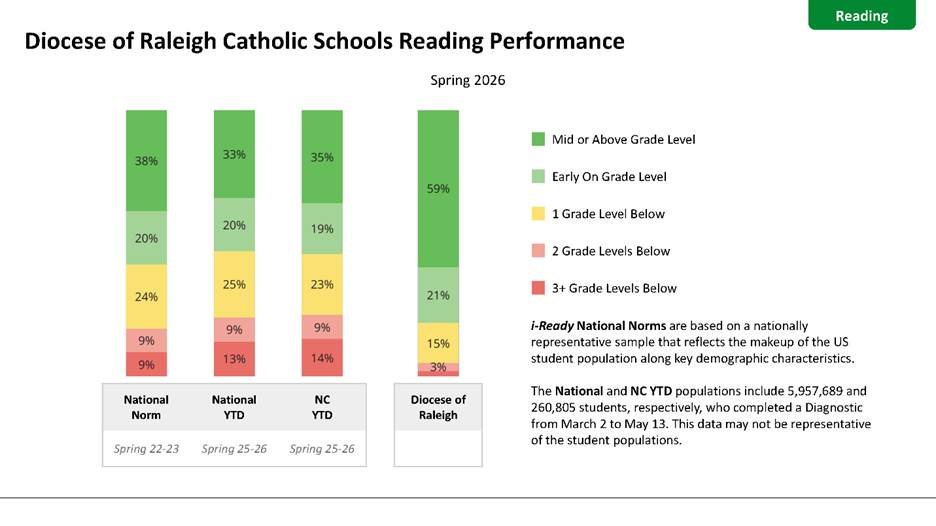
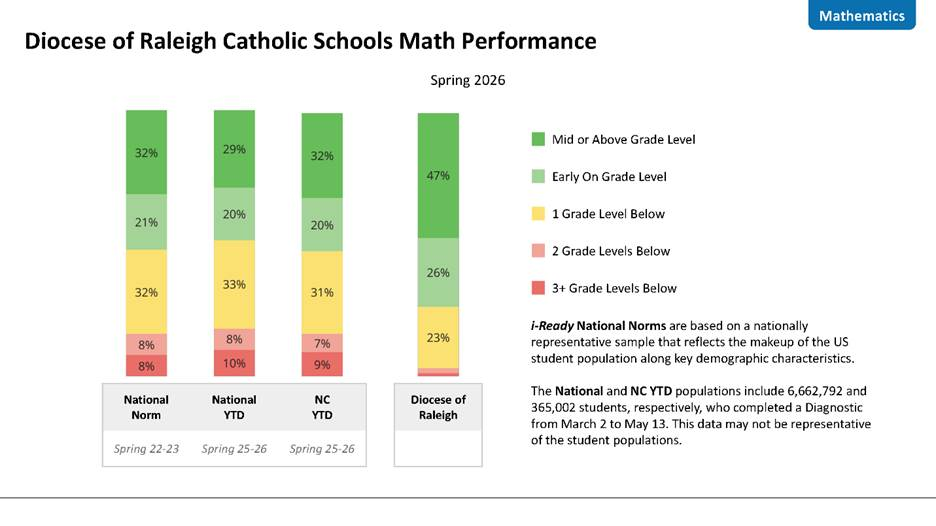
Students in the Diocese of Raleigh Catholic Schools are demonstrating outstanding academic achievement, significantly outperforming both national and state benchmarks according to Spring 2026 i-Ready diagnostic results. In mathematics, an impressive 47% of Diocese students are performing at or above their expected grade level—well above the 32% national norm and the 32% North Carolina year-to-date average. Reading results are even more striking, with 59% of Diocese students scoring mid or above grade level, compared to just 38% nationally and 35% across North Carolina. Together, these figures show that nearly three-quarters of Diocese of Raleigh students are reading and doing math at or above grade level, a testament to the strength of the academic experience our schools provide.
These results also reflect meaningfully fewer students falling behind. Only 23% of Diocese students are one or more grade levels behind in math, compared to 43% nationally and 40% statewide, while just 18% are behind in reading, versus 47% nationally and 46% across North Carolina. The percentage of students who are significantly behind—two or more grade levels—is similarly low across both subjects. These outcomes underscore the effectiveness of our teachers, curriculum, and individualized approach to student learning, and reflect the Diocese of Raleigh's ongoing commitment to academic excellence for every student in our care.