



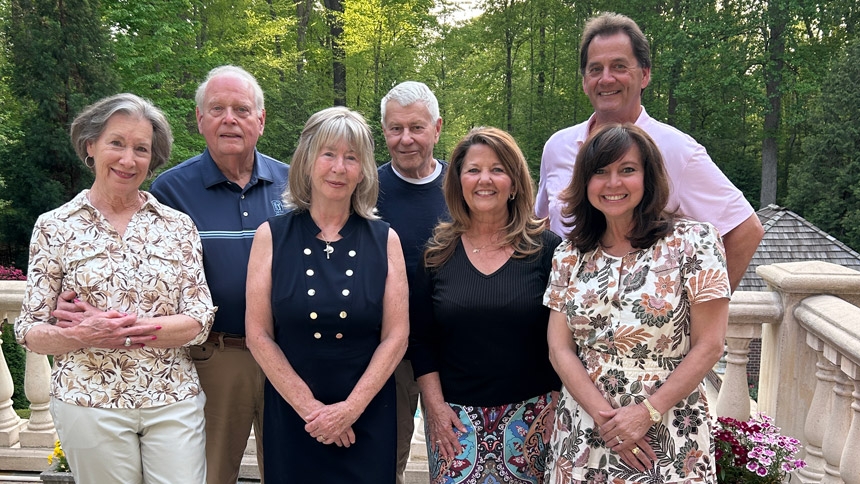
Above, left to right: Dabney Dougherty, Bill Dougherty, Fran Scherzer, Ray Scherzer, Monique Wertis, Joe Wertis and Marianne Schulz are parishioners of St. Catherine of Siena in Wake Forest. They started Amabilis in 2025. (Not pictured: Tim Schultz, Dale Dawson & Tina Dawson)
One conversation with Father Matthew Nwafor was all it took for five couples to decide they would build a medical clinic.
Over dinner with parishioners from St. Catherine of Sienna in Wake Forest, Father Matthew shared stories of the crushing poverty in his childhood home of Amaurulor, Nigeria —stories that deeply affected the group.
Amaurulor is a collection of four small villages where, until just three years ago, the area’s 2,000 residents drew their water from a creek up to two miles away. A donated well and water pump have improved their lives; yet medical care is non-existent.
The closest hospital is 20-30 miles away. Water-borne diseases still run rampant, along with malaria. With no maternal health care, infant mortality rates in Southeast Nigeria, where Amaurulor is located, are high at 25 – 57 per 1,000 births according to the World Health Organization. (For comparison, infant mortality is about 6.9 per 1,000 live births in North Carolina.)
“My big takeaway that night was the thought of all the kids being born on dirt floors. Oftentimes the mother passes away during birth,” said Joe Wertis, a parishioner at St. Catherine. “Sometimes the child passes away during birth, and sometimes both. That thought kept me awake most of the night.”
The five couples considered their own blessings and decided to build a clinic focused on maternal and child health that could also provide basic medical care for the wider community. They named the project Amabilis, a Latin word that means lovable, or worthy of love.
“We were inspired by Father Matthew, but we’ve also been guided by the Holy Spirit,” said Bill Dougherty, another partner in Amabilis, who said about 60 percent of residents in the Enugu state are Catholic. “Without the presence of the Holy Spirit in each of our lives providing the direction, I think we would truly be lost.”
The group purchased land for the clinic in 2025 and identified a local builder for construction. The architect and engineering designer is a professor at Godfrey Okoye University, a Catholic school in Enugu.
The Amabilis team has also arranged for the Daughters of Mary, Mother of Mercy, a religious congregation, to provide around-the-clock medical services at the clinic. The sisters are certified in nursing skills, so they can deliver babies, provide first aid and basic medical treatment and administer vaccines.
The clinic will be located next to the local school and serve the children there. Current plans call for a 9,200 square-foot building, with two delivery evaluation rooms for pregnant mothers, a neonatal room, a pediatric room, a laboratory, a pharmacy and a four-bed inpatient ward. Next to the clinic will be a house for the sisters with four bedrooms, a kitchen, living and dining rooms and a chapel. The compound will be surrounded by a wall with a guard house for security. Plans also include another well, solar panels and a backup generator.
The compound will be built in two phases: first the clinic, so the sisters can begin serving the community; then the home. The sisters insisted the clinic be built first.
Each of the 10 partners brings their special talents to the project. For example, Bill Dougherty chairs the Amabilis Board of Directors and brings his sales and marketing experience to fundraising; his wife, Dabney, was in real estate. Joe Wertis is in the marble tile terrazzo business; Dale Dawson runs a construction licensing board for the State of North Carolina and is a licensed plumbing contractor. Ray Scherzer is an electrical engineer with experience managing building projects. His wife, Fran, is a nurse, as is Marianne Schulz. Marianne helps create marketing materials and designed the website. Her husband, Tim, is board treasurer; he created the financial accounts needed to fundraise for a non-profit.
The total cost of the project is about $360,000 depending upon the exchange rates and fluctuating inflation which is currently 15.3% in Nigeria, said Dougherty. To date, the group has raised approximately $310,00, he added, and spent $10,000 on land, surveying, engineering and registrations.”
November through April are the driest times of the year in Nigeria, and best for construction. The Amabilis team hopes to have the necessary funds to begin the building process by the third quarter of this year.
They’ve held two fundraisers so far: a men’s corn-hole tournament, and a “Margaritas for Moms” launch party. However, most of the donations have resulted from one-on-one conversations.
Fran Scherzer is certain the financial support will come. “If we don’t help them, who will?” she said. “This is God’s will. We’re helping the poor. So, we have to trust in him.”
“We’re obligated to do something,” Dawson said. “The guy I follow, he was born on a dirt floor, too, practically, in the manger, and there probably wasn’t much difference between the two places. If we find it unacceptable for a baby to be born on a dirt floor in America, it shouldn’t be acceptable anywhere.”