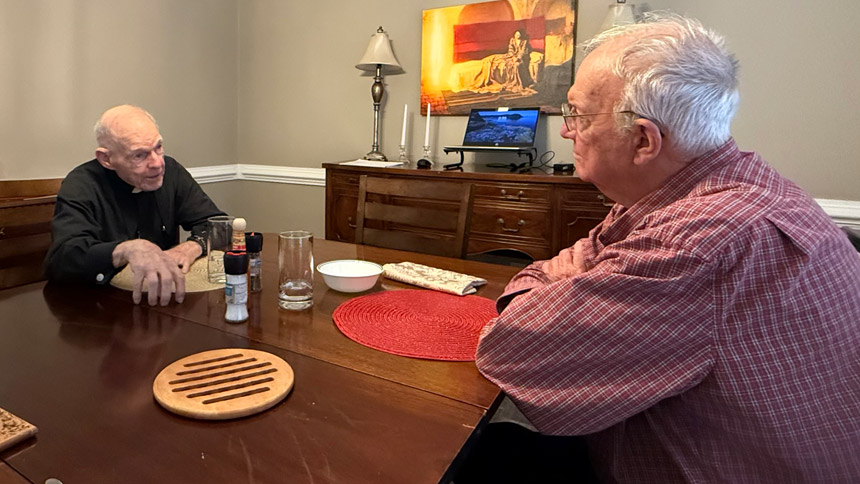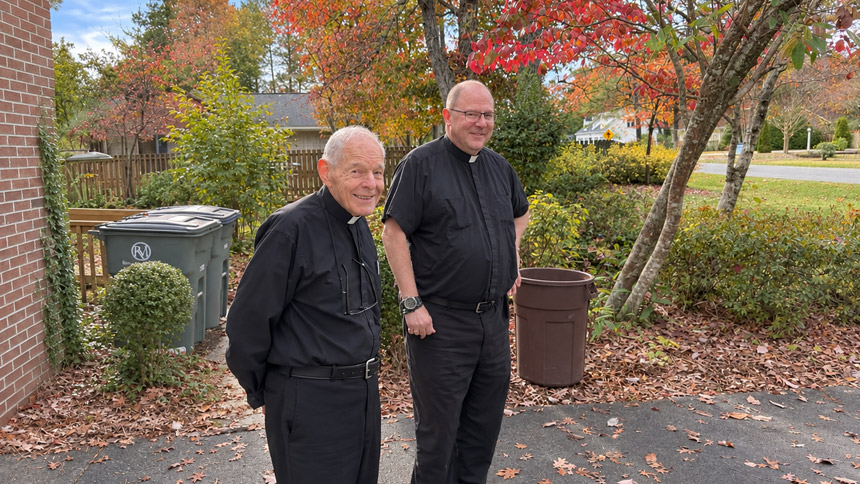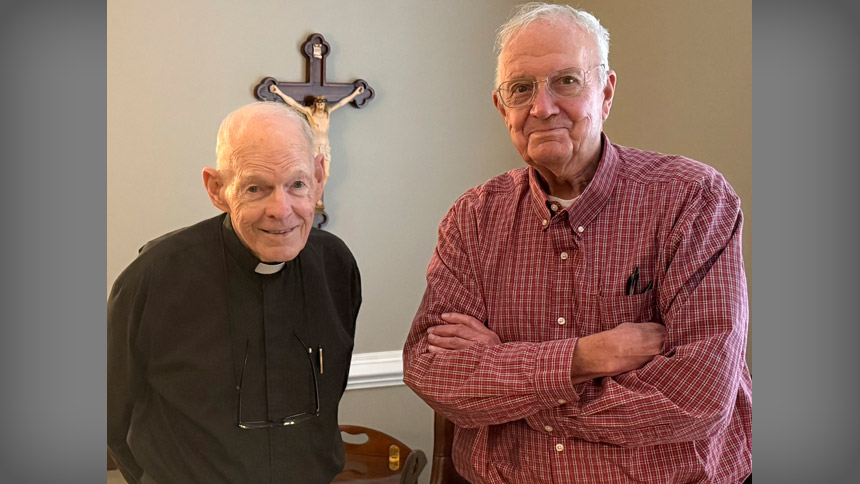


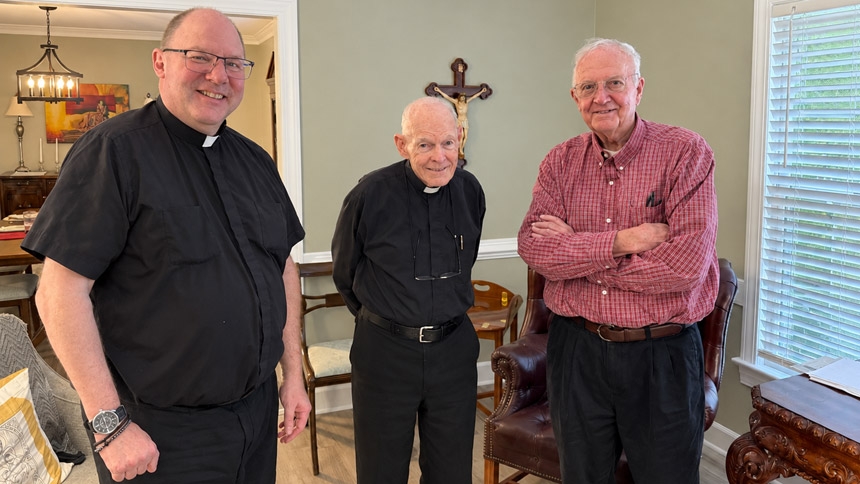
“You’re looking well, Richard!” said Monsignor John Williams to Father Richard Turner as he entered the Our Lady of Perpetual Help rectory in Rocky Mount.
“Your eyes must be failing you,” came the laughing reply.
With that, the two retired priests began a midafternoon Thanksgiving gathering at the invitation of their friend and Our Lady of Perpetual Help pastor, Father Nick Cottrill. There was plenty of food, plenty of laughter, and, as might be expected among three priests who have spent much of their lives serving the Church, plenty to talk about. But beneath the friendly conversation was something more meaningful: an appreciation for the brotherhood of the priesthood and the simple yet increasingly precious opportunity to share a meal.
As lunch cooked, they reminisced about family pets over the years. Father Cottrill recalled that a dog he adopted needed to be rehomed after he gave up a professional accounting career and a beloved pet to enter seminary as a young adult. Father Turner joked that local dogs, along with local deer, wander his property in Spring Hope and fulfill any need he has for pets.
They settled in for Father Nick’s home-cooked roast pork and sauerkraut, mashed potatoes, roasted vegetables, and hummus. Monsignor Williams thought the hummus was a fitting tribute to the Lebanese community that, for so many years, considered Our Lady of Perpetual Help a pilgrimage church in eastern North Carolina.
The joys and challenges of a changing Church
The conversation naturally turned to parish life and the challenges facing the Church today. Father Cottrill spoke about the importance of educational opportunity scholarships, which have opened the doors of Catholic education to so many families in Rocky Mount who might otherwise never have considered a Catholic school. Losing those opportunities would pose a significant challenge to Catholic education and the parishes that support it. They also discussed a familiar love and ongoing challenge in parish life: music. Finding and retaining qualified organists, music directors, and choir directors has become increasingly difficult.
Three journeys, one vocation
Each priest arrived at the Catholic priesthood by a different road. For Father Turner, the journey began in the Episcopal Church. A married former Episcopal priest, he was eventually drawn to the Catholic faith while serving as an Episcopal pastor in Akron, Ohio.
In retrospect, he joked, it may have happened through osmosis.
With an Italian Catholic parish at one end of the block and a Polish Catholic parish at the other, Father Turner spent considerable time in the company of these Catholic communities and their delicious dinners. Dinner invitations at the respective rectories became a regular part of life, and those relationships gradually brought him closer to the Church.
When he eventually decided to become Catholic and pursue the priesthood, he had one particular concern. “I worried that my late wife, Jane, wouldn’t be welcomed as the wife of a Catholic priest,” he recalled. Those fears quickly disappeared. In community after community, people welcomed Jane with open arms. In fact, Father Turner laughed more than once when someone suggested they should have ordained her instead.
Monsignor Williams’ path was different. After earning his degree at the University of North Carolina at Chapel Hill and later completing his doctorate in Georgia, he was asked how an English professor became a Catholic priest. The table quickly suggested that Flannery O’Connor must have had something to do with it. Monsignor Williams recalled the good fortune of seeing the celebrated Catholic writer at a reading at the University of Georgia shortly before her death. But when it came to his vocation, he offered a more personal explanation.
He went to Georgia, he admitted, in part to escape the possibility of a vocation. Looking back, he now tells others not to make the same mistake.
“Never do that,” he advises. A vocation, he has come to understand, is a gift from God, something to be embraced rather than avoided.
The gift of making time
The Thanksgiving season invites us to consider the many blessings we can overlook in the busyness of daily life. For these three priests, one of those blessings was the opportunity to pause and remember that the priesthood is not meant to be lived in isolation. The bonds of fraternity form and strengthen not only through shared ministry and prayer, but also through friendship, laughter, hospitality, and the willingness to make time for one another.
As the meal came to a close, Monsignor Williams offered a Latin expression of gratitude for that brotherhood: Ecce quam bonum et quam iucundum habitare fratres in unum. “How good and pleasant it is when brothers dwell together in unity.”
The words, drawn from Psalm 133, seemed a fitting conclusion to the afternoon. No grand celebration, no formal program, and no particular occasion beyond the approaching holiday. Just three priests, grateful for their vocation, their friendship, and the opportunity to gather.
Sometimes, the most meaningful expressions of thanksgiving are found around an ordinary table.