



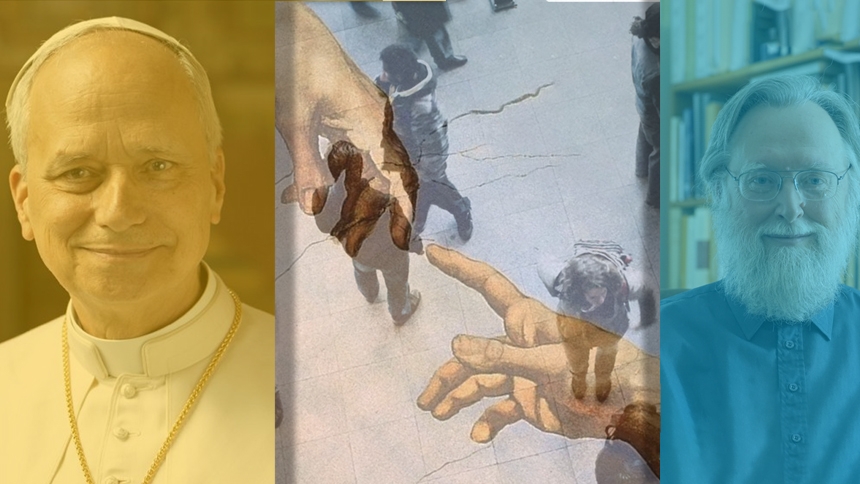
DURHAM, N.C. — Reinhard Huetter and his fellow theologians have been completing the work Pope Francis gave to them. The document they authored, titled Quo vadis, humanitas? Thinking through Christian Anthropology in the Face of Certain Scenarios for the Future of Humanity, was shared in English in early March.
Huetter, who holds two doctorates in theology, is a visiting professor of Catholic theology at Duke Divinity School and emeritus professor of fundamental and dogmatic theology at the Catholic University of America. He serves on the Vatican’s International Theological Commission, which collaboratively authored the document. He’s one of 28 theologians on the commission and one of nine in his subcommission that drafted the document. The commission advises the Dicastery for the Doctrine of the Faith and was established in 1969 by Pope Paul VI. Members are appointed by the pope and serve five-year terms. The commission is composed of men and women, all of whom are Catholic theologians. They are priests, religious and laity. Many describe the ITC as a think tank that examines doctrinal and moral questions of major importance.
In the case of Quo vadis, humanitas?, which translates to Where are you going, humanity?, topics include humanism, artificial intelligence, posthumanism, technology and life as a vocation. Pope Leo XIV approved the document, which was originally written in Italian, in 2025.
From his book-filled study in Durham, Huetter researched, reflected and wrote. He said most of his contributions fell into the first part of the document and center on AI. His focus on divinization, or becoming more like God, as true humanism may be read toward the end of the document.
A native of Lichtenfels, Germany, Huetter worked on the document in English drafts. Next to Italian, Spanish and French, English was one of the four languages the commission’s members used to communicate with each other. Members, he said, were coming from Australia, South Korea, India, Benin, Tanzania, the Democratic Republic of Congo, Argentina, Peru, Brazil, Mexico, Puerto Rico, Spain, France, Belgium, Germany, Austria, Italy, Slovenia, Slovakia, Ukraine, Lebanon and the United States.
The subcommission that worked on the document followed normal procedures, Huetter said, which, over the course of five years, included an annual spring meeting of the three subcommissions and a fall plenary meeting of the whole commission in Rome. During its final plenary session, which completed the five-year term, the full commission met the last week of November in Rome with Pope Leo XIV.
Father Michael Burbeck, vicar general of the Diocese of Raleigh, told NC Catholics that Pope Leo XIV has been clear that the challenges of AI are important to him and, because of that, chose the name Leo because Pope Leo XIII led the Catholic Church during a time of profound change — the Industrial Revolution.
Although this document is more exploratory in nature than an encyclical, most observers expect that Quo vadis, humanitas? is a precursor to Pope Leo XIV’s first encyclical, which is anticipated for later this year.
Both Father Michael and Huetter shared that the document calls attention to Gaudium et Spes, the 1965 pastoral constitution on the Church in the modern world. “Similarly, the Church was saying there were great risks,” said Father Michael, noting that the topic of that time was nuclear war.
Father noted that Quo vadis, humanitas? explores what is good for the human person because “if we don’t know or define what the good of the human person is, we can’t properly discern whether any given development is truly progress for humanity.” He added that, ultimately, the authors explain that Christ is the answer to the tensions that we experience.
“Dr. Huetter is brilliant and we are incredibly blessed to have a member of the ITC locally,” Father Michael said, adding that section 109 of the document especially resonated with him because of its reflection that “Human beings cannot be happy without knowledge of who they are.”
When asked how he’d explain the document’s contents to an everyday Catholic without a background in theology or philosophy, Huetter said, “It’s about what it means to be human, fundamentally … it’s to respond to God’s call by embracing one’s vocation in this world and thereby finding one’s unique human identity.”
He added that the document explores the integration of humans as social and political, as well as people who are seeking and developing.
“We have the gift of lives … the gift of community, the task for each one of us is to put this together in a journey forward,” he said, “a journey, ultimately, through grace, into God.”
Related stories: