



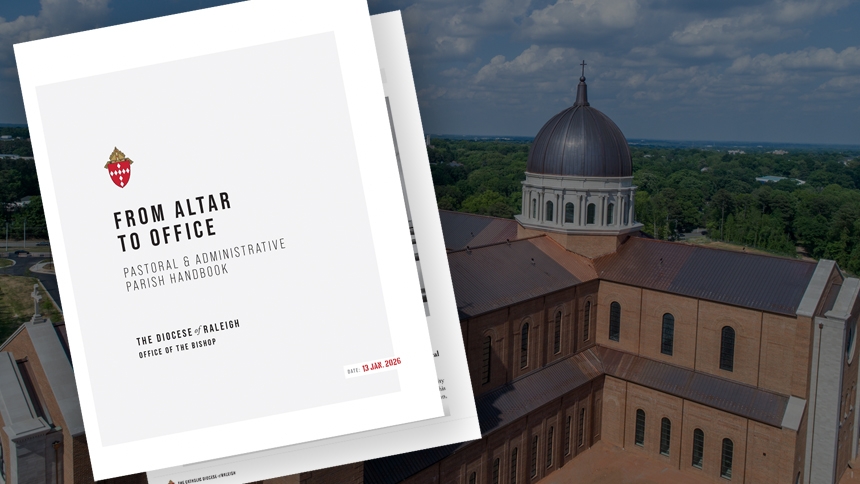
At the most recent Priest Assembly meeting in mid-January, the Diocese of Raleigh officially issued From Altar to Office, a new Pastoral and Administrative Parish Handbook, which will serve as an authoritative guide for parish leadership and ministry across the diocese.
Bishop Luis Rafael Zarama described the handbook as "a pastoral and practical resource for those who serve in leadership and ministry throughout the diocese, particularly pastors, clergy, parish staff, and lay ecclesial ministers." It compiles diocesan policies, canonical norms, and established practices "to support faithful ministry, sound administration, and responsible stewardship in service of the Church’s mission."
He encouraged all users to approach the handbook "in a spirit of collaboration, ecclesial communion, and pastoral charity, mindful that good governance serves the good of the people of God."
A living tradition of pastoral care
A pastoral handbook may appear to be a thoroughly modern development — another binder, another set of guidelines, another diocesan initiative. In reality, though, it is something far more familiar and deeply Catholic. This handbook is the latest chapter in a long story: the Church’s enduring effort to give her priests clear guidance, spiritual grounding, and practical direction so they can serve God’s people faithfully in the places where they are sent.
From the very beginning, Catholic ministry has required more than personal zeal. The apostles themselves received instruction, correction, and encouragement from the wider Church. Over the centuries, councils, bishops and popes have repeatedly returned to the same conviction: good pastoral care depends not only on holiness of life, but on sound organization, shared responsibility, and clarity of mission.
From Altar to Office stands squarely within that tradition — especially in eastern North Carolina, where Catholic life has always demanded creativity, patience, and careful leadership.
The roots of that story stretch back well before the Diocese of Raleigh existed. In the early 1800s, Catholicism in North Carolina was barely visible. Small groups of Catholics gathered quietly in homes or borrowed spaces, often without a resident priest. When Bishop John England of Charleston began visiting the region in the 1820s, he found fewer than 150 adult Catholics and no formal parishes. Yet England did not respond with despair or rigidity. He adapted. He encouraged lay-led prayer when priests were unavailable, promoted the construction of modest churches as centers of stability and insisted on lay participation in parish life. He preached wherever doors were open — sometimes in courthouses or Protestant buildings. He slowly helped a fragile Catholic presence take root in hostile or indifferent soil.
A mission church learns to govern
That same missionary realism would later define the work of James Gibbons, who was named a bishop and appointed apostolic vicar of North Carolina in 1868 by Pope Pius IX. At just 34 years old, Gibbons was responsible for an entire state still considered mission territory, with only a few thousand Catholics and very few priests. He traveled extensively under difficult, post–Civil War conditions, encouraging clergy to serve isolated communities and urging patience in a predominantly Protestant culture.
Gibbons understood that evangelization required credibility, good citizenship, and a pastoral style that combined conviction with prudence — an approach that would later make him one of the most influential American churchmen of his era.
Gibbons, who was named a cardinal in 1886, also understood something else: priests need guidance. In 1896, long after his North Carolina years, he published The Ambassador of Christ, a substantial work addressed directly to clergy. It explored the spiritual life of the priest, his duties, his relationship to authority, and his role in society. The book was not a rulebook in the narrow sense, but a pastoral guide — an effort to help priests live their vocation faithfully amid changing cultural conditions. In that sense, it belongs to the same family as diocesan handbooks today.
By the time the Diocese of Raleigh was formally erected in 1924, the Church in eastern North Carolina was moving from mission territory toward a more stable ecclesial life. The territorial reconfiguration of 1971 further clarified pastoral focus, but perhaps the most decisive moment of institutional maturity came in 1990, when the diocese formally adopted its Mission Statement through diocesan councils. This marked a shift from reactive growth to intentional planning, and from ad hoc responses to shared discernment.
Bishop F. Joseph Gossman articulated this vision with striking clarity. “The planning task is never finished,” he reminded the diocese, insisting on constant monitoring and adaptation. He also emphasized that “the parish is the place where most people experience the reality of the Church,” and therefore must remain the central focus of diocesan ministry. For Bishop Gossman, organization was not opposed to pastoral care; it was essential to it. Structure, rightly ordered, serves mission.
That conviction took concrete form in the Pastoral Administrative Manual of 2004, which translated vision into policies and procedures. The Parish Ministry Handbook of 2011, though never formally promulgated, further shaped diocesan culture by providing a common language and framework for pastoral reflection. Even without juridical force, it guided practice and expectations across parishes.
From Altar to Office builds on all of this. It does not represent a new direction so much as a mature expression of a long trajectory — one that stretches from Bishop England’s frontier adaptability, through Gibbons’ missionary patience and pastoral wisdom, to a modern emphasis on shared responsibility and intentional planning. The handbook recognizes a simple truth: priests today serve in complex environments that require not only sacramental ministry, but leadership, administration, collaboration with lay leaders, and accountability to the wider Church.
Why this matters for every parish
For lay Catholics, this matters more than it may first appear. When priests are supported by clear guidance and sound structures, they are freer to do what they are ordained to do: preach the Gospel, celebrate the sacraments, accompany families, and build up parish communities. A handbook like From Altar to Office is not about bureaucracy for its own sake. It is about ensuring that the life of grace flowing from the altar is supported — not hindered — by the work of the office.
In that sense, the Diocese of Raleigh is not starting from zero. It is harvesting the fruit of more than 150 years of faithful growth. From Altar to Office stands as a sign of a local Church that has learned to govern wisely, plan responsibly, and serve pastorally—rooted in tradition, attentive to history, and confident in its mission for the future.